
Guide for therapists with out-of-network clients
Superbills for Therapists
A superbill is the itemized bill you give an out-of-network client so they can ask their insurer to pay them back. Insurers' claim forms ask for the same core details: your name, address and tax ID; the client's name; and for each session the date, a description, the procedure code, the diagnosis code and the charge. The client attaches it to their insurer's claim form. Cigna, for example, needs the claim within 180 days of the session unless the plan or state law allows more.
By Nasar Haq, Founder and CEO, Medtransic. Last reviewed 2026-10-05.
One session, itemized
IllustrativeSuperbill
- Provider name and address
- Required
- Provider tax ID
- Required
- Client name
- Required
- Date of service
- Each session
- Description of service
- Each session
- Procedure code
- Each session
- Diagnosis code
- Each session
- Charge
- Each session
- Paid by client
- Shown in full
- Core items
- 9
- asked for by at least three insurers
- Cigna deadline
- 180 days
- from the session, unless the plan allows more
- Medicare
- Rarely
- enrolled providers must file the claim themselves
- Who files it
- The client
- with their insurer's claim form
Why clients do not get paid back
Usually the bill was fine for the client and wrong for the insurer.
- A detail the insurer needs is missing
- No tax ID, no diagnosis code, or one total instead of a line per session. The insurer sends the claim back to the client.
- It arrives too late
- Plans set a deadline for members filing their own claims. Cigna's forms say 180 days from the session, unless the plan or state law allows more.
- It goes on the wrong form
- Some insurers have a separate claim form for behavioral health. Cigna does, for example. The client should use the one that matches their benefit.
- The client is on Medicare
- If you are enrolled in Medicare, you must file the claim yourself. A superbill is not the route.
What we can take on, and what stays with you
Medtransic runs
- Superbills for your out-of-network clients, with every item insurers ask for
- In-network claims, if you want to join the plans your clients carry
- Credentialing with those plans, at $150 per application, per provider
Your practice keeps
- Your fees and your self-pay policy
- Which clients get a superbill
- Collecting payment from the client
What to put on every superbill
Each of these is asked for on at least three insurers' member claim forms.
- 01
Your name and address
- Why the insurer needs it
- To know who gave the care
- 02
Your tax ID
- Why the insurer needs it
- To identify you as the provider
- 03
Client name
- Why the insurer needs it
- To match the claim to their member
- 04
Date of service
- Why the insurer needs it
- One line per session, to check coverage and deadlines
- 05
Description of service
- Why the insurer needs it
- To know what kind of session it was
- 06
Procedure code
- Why the insurer needs it
- To price the session under the plan
- 07
Diagnosis code
- Why the insurer needs it
- To decide whether the care is covered
- 08
Charge per service
- Why the insurer needs it
- To work out what the plan pays back
How a client gets paid back
The client does the filing. Your job is a superbill that has everything on it.
- 01
The client pays you
At the session or on your usual schedule.
- 02
You give a superbill
One line per session, with every item in the table above.
- 03
The client gets their insurer's claim form
From the insurer's website. Behavioral health may have its own form.
- 04
The client files it in time
Within the plan's deadline. Cigna's forms say 180 days from the session unless the plan or state law allows more.
- 05
The insurer pays the client
At the plan's out-of-network rate, after any deductible.
Payer notes
Medicare
Providers who are enrolled must file Medicare claims themselves, within 12 months of the service. A client can file their own claim on Form CMS-1490S, but claims for providers who are not enrolled may be denied.
Self-pay clients
Clients who are uninsured, or who choose not to use insurance, must get a good faith estimate of what their care will cost (No Surprises Act).
Plans differ
Each plan sets its own out-of-network benefit and deadline. The client's plan documents have the answer.
Your client portal, included
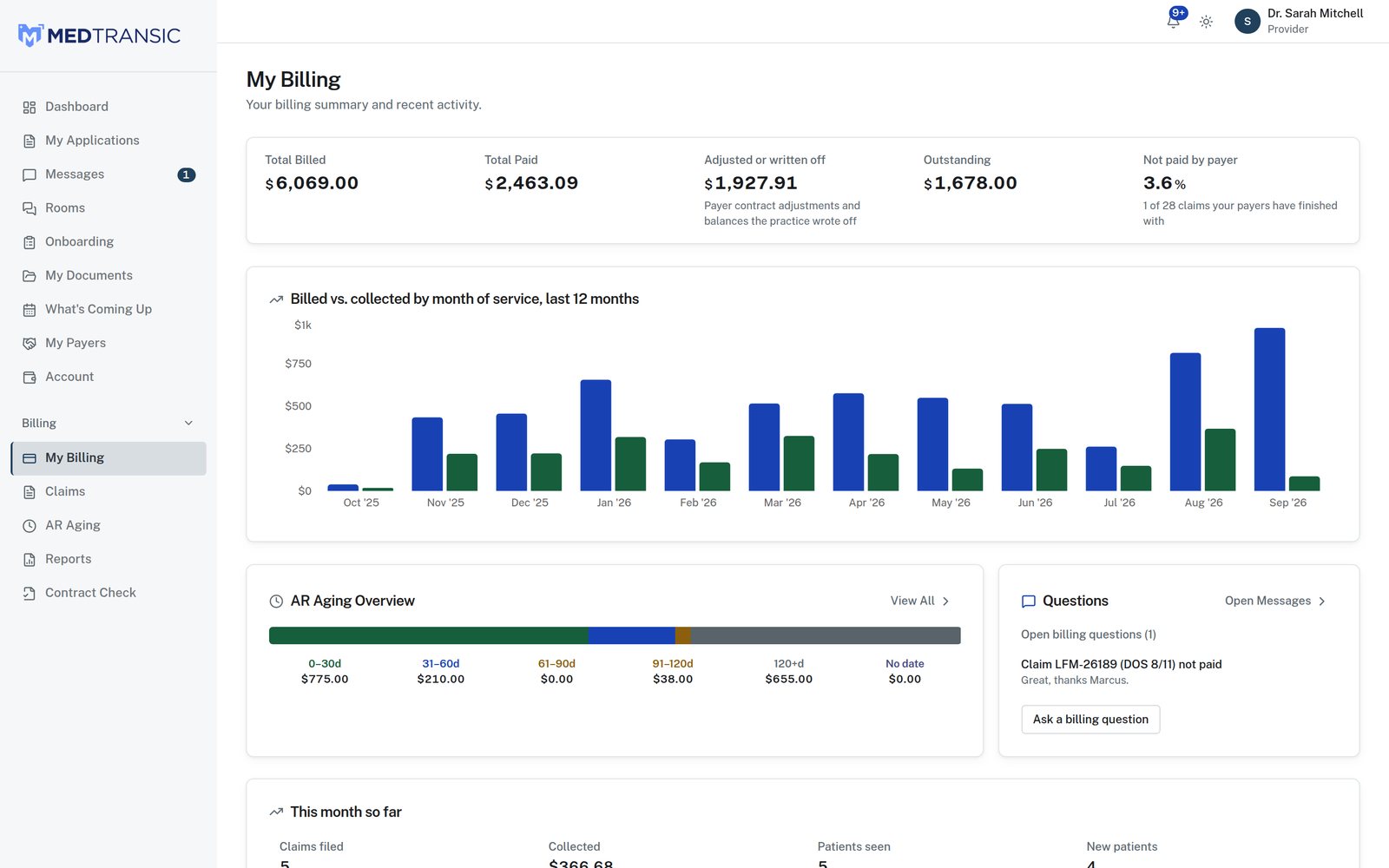
Your EHR shows what you billed. Your portal shows what we are doing about it.
Your EHR or practice management system runs your practice, but it does not show you our work. The Medtransic HIPAA Compliant Portal does: every claim and its current stage, the denials we are working, your A/R by age, each payer application and its in-network date, and the documents we still need from you. It is the same record our team works from, and it comes with every client account.
- Did that claim get paid?
- Every claim with its stage and amount, the denials we're working, and your receivables by age.
- Where is my application with Aetna?
- Each payer application shows its stage, its history, and the date you can start seeing that payer's patients.
- What do you still need from me?
- One list of the documents we're waiting on. Upload once, and it reaches every payer that asked for it.
When a superbill is the wrong tool
- If you are in network with the client's plan, bill the plan directly. A superbill is for clients whose plan you are not in.
- If many of your clients carry the same insurer, joining that network may serve them better than a superbill. That is what credentialing is for.
Questions about superbills
What is a superbill for therapists?
An itemized bill you give a client who paid you directly, so they can ask their insurer to pay them back. It lists your details, the client, and each session with its codes and charge.
What has to be on a superbill?
At least your name, address and tax ID, the client's name, and for each session the date, a description, the procedure code, the diagnosis code and the charge. Some insurers also ask for your NPI, the place of service and proof of payment.
How long does a client have to submit a superbill?
It depends on the plan. Cigna's claim forms say 180 days from the session, unless the plan or state law allows more. Clients should check their own plan.
Can Medicare clients use a superbill?
Usually not. If you are enrolled in Medicare, you must file the claim yourself. If you have opted out of Medicare, Medicare does not pay for your services.
Do you prepare superbills?
Yes, for practices we bill for, if you want them. We can also get you in network with the plans your clients carry.
Keep reading
- Billing services for therapists →
- Insurance paneling for therapists →
- Insurance credentialing for therapists →
- Headway, Alma, Grow and Rula vs your own contracts →
+ − Sources: 10 checked 2026-10-05
- Cigna, Behavioral health member claim form, checked 2026-10-05
- Cigna, Medical claim form, checked 2026-10-05
- Aetna, Medical claim form, checked 2026-10-05
- UnitedHealthcare, How to submit a claim, checked 2026-10-05
- Anthem Blue Cross, Member medical claim form, checked 2026-10-05
- Blue Cross and Blue Shield of Texas, Medical claim form, checked 2026-10-05
- Medicare.gov, How do I file a claim?, checked 2026-10-05
- CMS, Form CMS-1490S, Patient Request for Medical Payment, checked 2026-10-05
- Medicare.gov, Does your provider accept Medicare as full payment?, checked 2026-10-05
- CMS, No Surprises Act: overview of rules and fact sheets, checked 2026-10-05
Book a free revenue audit
We look at a sample of your actual claims and show you, line by line, where money is going uncollected. No commitment follows it.