
Guide for out-of-network therapists
What Is a Single Case Agreement? A Guide for Therapists
A single case agreement is a one-time contract between an insurance company and an out-of-network provider to treat one client, for a set period, at in-network cost to that client. Insurers grant one when their network has a real gap: no in-network clinician nearby, none with the right specialty, or none with a reasonable wait. Preference is not enough. Each insurer has its own name for it: UnitedHealthcare says "network gap exception", Cigna's Evernorth says "network exception request" and Aetna says "nonparticipating referral".
By Nasar Haq, Founder and CEO, Medtransic. Last reviewed 2026-11-10.
Two pieces of paper, one client
IllustrativeA client needs a therapist the network does not have
Gap exception
- Asks the plan to pay as if you were in network
- Started by the client, their doctor or you, depending on the insurer
- Changes what the client pays
Single case agreement
- A contract between you and the insurer
- Names the client, the services and the dates
- Sets what you are paid
- Covers
- One client
- with one provider, for a set period
- Client pays
- In-network cost
- once the exception is approved
- Cigna standard
- 15 or 25 miles
- urban or rural; first visit within 10 business days
- Ohio Medicaid
- 120 days
- one single case enrollment only
Why requests get denied
Most denials come down to one thing: the insurer believes an in-network clinician could treat the client.
It reads as preference
Cigna's policy says a request must not be "based on personal preference or convenience". Health Net denies preference requests once it finds one suitable in-network clinician.
An in-network option is within reach
Cigna will not approve one if an in-network provider is within the distance the client would travel to you, "no matter how many miles that may be".
The request is vague
Evernorth returns forms with "omissions, generalities, and illegibility". Its form asks why your specialty is "uniquely available from this provider".
Telehealth is part of the plan
Cigna's network adequacy policy says it "does not apply" to telemedicine. Ask before you plan video-only sessions under an exception.
The client already has out-of-network benefits
The insurer may simply pay its out-of-network benefit. Carelon needs no signed agreement then: the plan's own benefit design sets the payment.
What we handle, and what stays with you
Medtransic runs
- Single case agreement requests for providers we are credentialing with that insurer
- Credentialing with that insurer, at $150 per application, per provider, so the next client needs no exception
- Billing the approved sessions, if you want us to, at 4-8% of collections
Your practice keeps
- The clinical reason and your notes
- Whether to accept the rate the insurer offers
- Telling your client what they will owe
What each insurer calls it
Use the insurer's own term and form. Each line comes from that insurer's own documents, read on November 10, 2026.
- 01
UnitedHealthcare (commercial)
- Its term
- Network gap exception
- How it starts
- A prior authorization first, then the gap exception form with its case number
- 02
Cigna / Evernorth Behavioral Health
- Its term
- Network exception request
- How it starts
- The clinician emails the form to NER@Evernorth.com or faxes 860.687.7329
- 03
Aetna (commercial)
- Its term
- Nonparticipating referral or out-of-network exception
- How it starts
- Preapproval: call the precertification number on the member ID card
- 04
Highmark
- Its term
- Gap exception or out-of-network referral
- How it starts
- The "Network Exception" question inside the prior authorization request
- 05
Carelon Behavioral Health
- Its term
- Single case agreement
- How it starts
- The provider or the member calls the number on the member ID card
- 06
Anthem (Ohio Medicaid)
- Its term
- Single case agreement
- How it starts
- A prior authorization, plus Ohio Medicaid forms ODM 10282 and ODM 10295
- 07
Magellan (Pennsylvania Medicaid)
- Its term
- Single case agreement
- How it starts
- Only once all in-network options are exhausted
How to request one, step by step
The forms differ by insurer. The evidence that wins is the same.
Check the plan
Find out who manages the client's behavioral health benefit, such as Carelon or Evernorth. Check whether the plan has out-of-network benefits.
Show the gap
Search the insurer's directory for clinicians who fit the client, and note who is full, too far or lacks the specialty. Cigna's standard is 15 miles urban, 25 rural, and a first routine visit within 10 business days.
Write the clinical reason
Say why your training or approach is needed for this client. UnitedHealthcare asks for details of any "specialized training or techniques".
Send it on the insurer's form
Include the diagnosis, the services and visits, the start date and your clinical notes. Open the prior authorization first where the insurer requires it.
Read the agreement before you start
Check the client, services, dates and rate. Carelon loads its rates after 10 days even if you have not signed.
Bill to the agreement
Use the authorization number the insurer gives you on every claim, and file on time. Carelon wants out-of-network claims within 90 days of the session unless a plan or state rule says otherwise.
Ask for more time before it ends
At Carelon, an approved extension keeps the existing rates. Ask while treatment is still running.
Credentialing still pending? Carelon's review checks whether "there is a provider application in process to become in-network", but no insurer we read promises an agreement for that reason. Ohio Medicaid allows only one 120-day single case enrollment, so treat an agreement as a bridge, not the plan.
Medicaid, Medicare, TRICARE and the No Surprises Act
Medicaid managed care
You usually must be enrolled with the state Medicaid program first. In Ohio, plans may not contract with unenrolled providers, and the single case form gives one 120-day enrollment.
Original Medicare
There is no network. A client can see any provider who takes Medicare.
Medicare Advantage
When an in-network provider is "unavailable or inadequate", the plan must cover the care out of network at in-network cost sharing. Networks must include behavioral health providers.
TRICARE
The regional contractors' documents we read do not use single case agreements. A TRICARE-certified provider can see clients as non-network, and Humana Military (East) is accepting mental health providers into its network.
No Surprises Act
If your contract with a plan ends while a client is treated for a serious and complex condition, the client can keep you on in-network terms for up to 90 days. You accept the plan's payment plus cost-sharing as payment in full.
New plan members
Transition of care lets a new member keep an out-of-network therapist for a set time. Evernorth approvals usually last 90 days; UnitedHealthcare Exchange plans need the request within 30 days of enrollment.
Your client portal, included
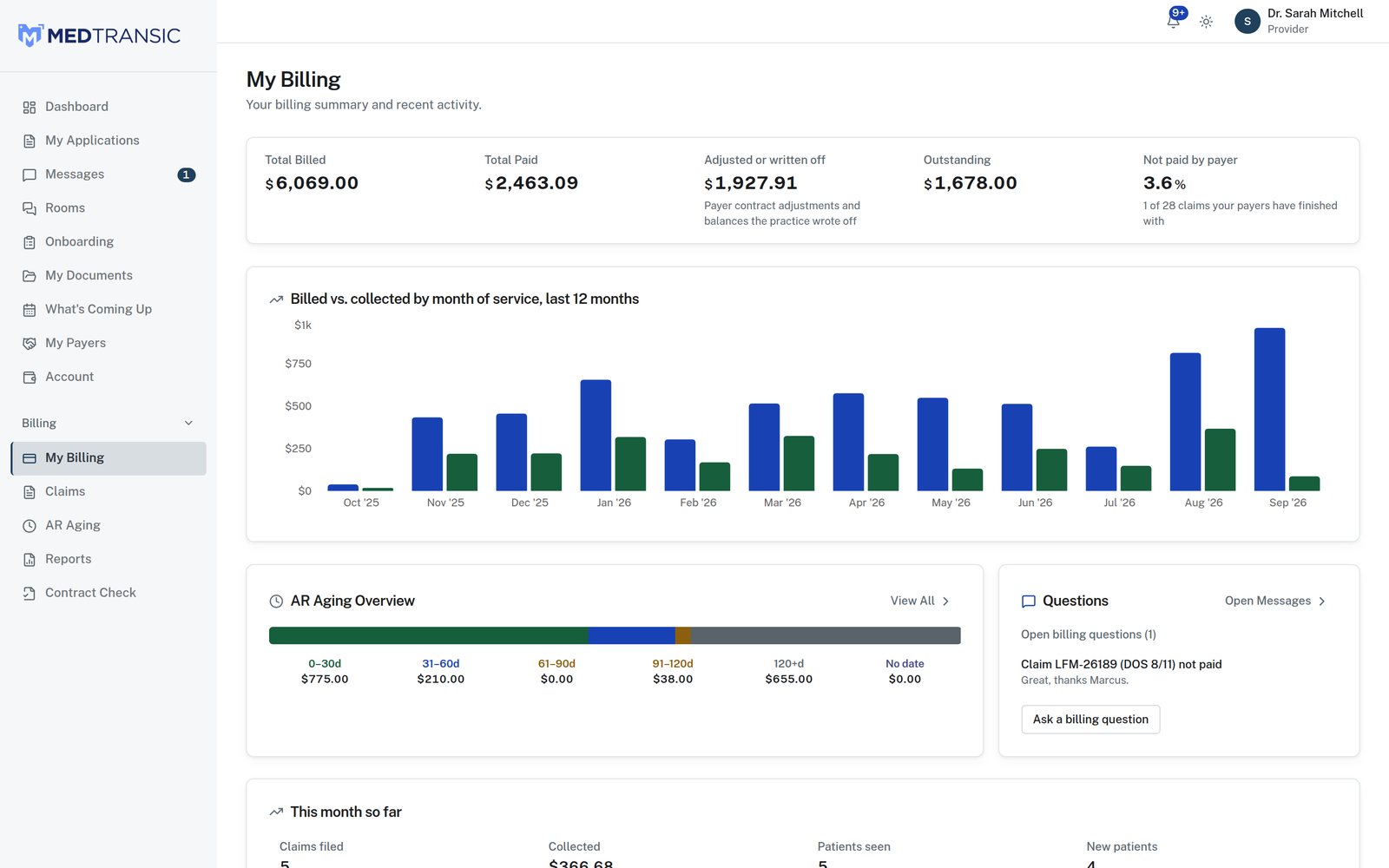
Your EHR shows what you billed. Your portal shows what we are doing about it.
Your EHR or practice management system runs your practice, but it does not show you our work. The Medtransic HIPAA Compliant Portal does: every claim and its current stage, the denials we are working, your A/R by age, each payer application and its in-network date, and the documents we still need from you. It is the same record our team works from, and it comes with every client account.
- Did that claim get paid?
- Every claim with its stage and amount, the denials we're working, and your receivables by age.
- Where is my application with Aetna?
- Each payer application shows its stage, its history, and the date you can start seeing that payer's patients.
- What do you still need from me?
- One list of the documents we're waiting on. Upload once, and it reaches every payer that asked for it.
When a single case agreement is the wrong tool
- If several clients carry the same insurer, join its network instead. An agreement covers one client, and the next one starts again from nothing.
- If the client has out-of-network benefits, a superbill may be simpler. The client pays you and claims their own out-of-network benefit.
Questions about single case agreements
What is a single case agreement with insurance?
A one-time contract between an insurer and an out-of-network provider for one client. Carelon describes it as setting "the terms and conditions for the provision and reimbursement of specified covered services for a particular member during a defined period of time."
What does SCA stand for in insurance?
Single case agreement. Carelon, Magellan and Anthem's Ohio Medicaid plan use the term; UnitedHealthcare, Cigna and Aetna use other names for similar exceptions.
Is a gap exception the same as a single case agreement?
Not quite. A gap exception asks the plan to apply in-network benefits to an out-of-network provider; a single case agreement is the contract that sets the provider's terms and pay. Carelon, for example, approves out-of-network care and asks for a signed agreement only when the plan has no out-of-network benefits.
Who asks for a single case agreement, the client or the provider?
It depends on the insurer. At Carelon either can call; Evernorth wants the treating clinician to complete its form; UnitedHealthcare's Maryland and Connecticut member forms start with the member calling Member Services.
How long does a single case agreement take to approve?
Most insurers do not publish a time. Carelon's single case agreement team works to 10 business days, and Evernorth reviews transition of care requests within 10 days.
How long does a single case agreement last?
As long as the agreement says. No insurer we read sets one limit for all cases; Evernorth transition of care approvals usually last 90 days, and Ohio Medicaid single case enrollment lasts 120 days.
Is a single case agreement the same as a prior authorization?
No. UnitedHealthcare and Anthem's Ohio Medicaid plan make you open a prior authorization first and then request the exception, and Carelon says not every authorized service needs a signed agreement.
Can I get a single case agreement while my credentialing is pending?
Sometimes. Carelon checks for a pending network application when it reviews a request, but no insurer we read promises an agreement for that reason, and Ohio Medicaid allows only one 120-day single case enrollment.
Can I bill the client the difference?
Usually not. When Carelon approves out-of-network care because of an access issue, the provider accepts its payment as payment in full except the client's cost share. Check the wording of your own agreement.
Do you request single case agreements for practices?
Yes, for providers we are credentialing with that insurer. Credentialing is $150 per application, per provider.
Keep reading
- Superbills for therapists →
- Credentialing by insurer, for therapists →
- Insurance credentialing for therapists →
- How to get paneled with insurance →
- Billing services for therapists →
+ − Sources: 23 checked 2026-11-10
- UnitedHealthcare, Network Gap Exception Request Form instructions (commercial, 07/31/2024), checked 2026-11-10
- UnitedHealthcare, Maryland Network Prior Authorization Gap Exception Request Form (member), checked 2026-11-10
- UnitedHealthcare, Individual Exchange plans quick reference guide for out-of-network providers, checked 2026-11-10
- Evernorth, Outpatient Behavioral Network Exception Request Form (Rev. 03/2024), checked 2026-11-10
- Evernorth, Transition of care and continuity of care FAQ (03/25), checked 2026-11-10
- Cigna, Network Adequacy Provision policy (reviewed 3/10/2026), checked 2026-11-10
- Aetna, Provider manual (out-of-network referrals), checked 2026-11-10
- Aetna, State-specific information for members (out-of-network exceptions), checked 2026-11-10
- Highmark, Network Exception question special bulletin (August 27, 2025), checked 2026-11-10
- Carelon Behavioral Health, Out-of-Network Provider Guide and FAQ (rev. 09/04/2026), checked 2026-11-10
- Carelon Behavioral Health, SCA and OON Reimbursement Policy NM 301.11 (08/25/25), checked 2026-11-10
- Magellan of Pennsylvania, IBHS provider workgroup (October 8, 2026), checked 2026-11-10
- Health Net, Position statement on criteria for single case agreements (behavioral health), checked 2026-11-10
- Anthem Ohio Medicaid, Single Case Agreement FAQ (June 2023), checked 2026-11-10
- Ohio Department of Medicaid, provider enrollment memo for managed care (May 20, 2025), checked 2026-11-10
- Ohio Department of Medicaid, ODM 10295 Out-of-Network and Single Case Agreement Provider Application, checked 2026-11-10
- 42 CFR 438.602 (Medicaid managed care provider enrollment), CFR as of Oct. 1, 2025, checked 2026-11-10
- 42 CFR 422.112 (Medicare Advantage access to services), CFR as of Oct. 1, 2025, checked 2026-11-10
- Medicare.gov, Compare Original Medicare and Medicare Advantage, checked 2026-11-10
- 42 U.S.C. 300gg-113, Continuity of care (No Surprises Act), checked 2026-11-10
- 42 U.S.C. 300gg-138, Continuity of care (provider requirements), checked 2026-11-10
- Humana Military, TRICARE certification applications (East), checked 2026-11-10
- TriWest, TRICARE referral and authorization guidelines (West), checked 2026-11-10
Book a free consultation
We look at a sample of your actual claims and show you, line by line, where money is going uncollected. No commitment follows it.